
Complete Guide to Calibration in Quality Monitoring for Call Centers
Learn how to conduct effective calibration sessions to ensure consistency and fairness in agent evaluations.
Calibration refers to the process of monitoring and standardization among different quality monitors. The purpose of calibration is to ensure consistency and fairness in evaluating Call Center agent performance.
How is calibration performed?
1 Contact selection for calibration
To initiate the calibration process, a person from the quality monitoring team will select a specific contact to be used as a reference. This contact can be chosen randomly or based on predefined criteria, such as a representative example of the interaction between operators and customers.
2 Specialist selection
After selecting the contact, the person responsible for calibration must decide which specialist will be responsible for evaluating this interaction. The specialist is usually someone with extensive knowledge and experience in the subject matter, who has specific skills to analyze and correctly score the quality aspects involved in customer service.

3 Participant definition
During the calibration process, it's important to involve other people from the quality monitoring team. Participant selection may vary, but generally includes monitors responsible for daily call evaluation. This diversity of participants is fundamental to obtain a comprehensive perspective on service quality.
4 Deviation comparison
After evaluations are performed by monitors, it's necessary to compare deviations in relation to scores assigned by the specialist. This comparison is important to identify discrepancies and adjust possible differences in perception and evaluation criteria among monitors. It's common for variations to occur in assigned scores, and the goal is to minimize these differences as much as possible to ensure a more uniform and accurate evaluation.
By comparing deviations, monitors have the opportunity to analyze differences in their evaluations in relation to the specialist. This allows identification of improvement points, adjustments in evaluation criteria, and exchange of best practices among the team.
In summary: Calibration in quality monitoring in call centers is a process that aims to ensure consistency and accuracy of evaluations performed by monitors. Through contact selection for calibration, specialist choice, participation of multiple monitors, and deviation comparison, it's possible to obtain a more aligned evaluation and provide fairer and more effective feedback to call center operators. This contributes to improving customer service quality and overall team performance.
Which contact should be chosen for calibration?
When performing calibration in quality monitoring in call centers, proper selection of the contact used as reference is fundamental to ensure an efficient and comprehensive process. See the main factors:
Contacts with agent responses
A valid option is to choose contacts where agents themselves have contested the evaluation. These cases provide an opportunity for discussion and alignment among monitors to understand different perspectives and ensure a more accurate evaluation.
Contacts of greater difficulty
Opting for contacts that present greater complexity or challenge is also a valid approach for calibration. These interactions may involve dissatisfied customers, complaint situations, or complicated demands. By evaluating these contacts together, monitors can align their perceptions and improve evaluation in these more difficult cases.
Contacts presenting non-standard situations
Selection of contacts that deviate from the common service standard can be useful for calibration. These unusual situations may involve atypical aspects, such as complex technical problems, unusual demands, or special requests. By analyzing and scoring these contacts together, monitors can align their evaluations and develop consistent criteria for dealing with out-of-the-ordinary scenarios.
Contacts that allow evaluation of all form items
It's important to choose contacts that address all elements and criteria present in the evaluation form. This way, it's possible to ensure complete calibration, in which all relevant aspects of service are covered. This contributes to a more comprehensive and accurate evaluation of operator performance.
Contacts with scores outside the quality average
Including contacts that received significantly high or low scores in previous evaluations can be useful for calibration. These interactions allow a more detailed analysis of the reasons behind extreme scores and help identify discrepancies or inconsistencies in monitor evaluations.
Contacts of new products or services
When introducing new products or services, it's important to select contacts related to these new products for calibration. These interactions allow evaluation of understanding and correct handling of information about newly launched products or services. Additionally, they provide an opportunity for monitors to familiarize themselves with the particularities of these novelties and align their evaluations.
How to choose the specialist for calibration?
Specialist choice plays a crucial role in ensuring process efficiency and consistency. When selecting the professional responsible for this function, it's necessary to consider some essential qualities and attributions. Below are the main points about what the specialist will need:
Facilitate calibration sessions
The specialist must have facilitation skills to conduct calibration sessions effectively. This includes establishing a collaborative and respectful environment, promoting active participation of all involved. The specialist must ensure discussions focus on relevant evaluation aspects and that there's space to exchange ideas and clarify doubts.

Provide guidance and clarification
It's the specialist's responsibility to provide clear guidance to monitors during calibration sessions. They must clarify evaluation criteria, explain key points to consider, and help participants understand established quality standards. The specialist must also offer constructive feedback and improvement suggestions, promoting continuous monitor development.
Document calibration results
The specialist must be diligent in documenting results and conclusions reached during calibration sessions. These records are fundamental for tracking progress over time, identifying trends, and assisting in the review process. Additionally, documentation allows consistent and reliable reference for future calibrations and quality monitoring program improvements.
Generate consistency in evaluations
One of the specialist's main objectives is to ensure consistency in evaluations performed by monitors. This involves defining clear guidelines and evaluation criteria to minimize subjectivity and discrepancies in scores. The specialist must share concrete examples, provide case studies, and work closely with monitors to achieve common understanding and consistent evaluation approach.
In addition to the skills mentioned above, the specialist chosen for quality monitoring calibration in Call Centers must have the following competencies:
- ✓ Monitoring experience: It's essential that the specialist has previous experience in quality monitoring.
- ✓ Strong understanding of criteria: Must have solid knowledge of evaluation criteria and standards.
- ✓ Good communication: Communication skills are essential for the calibration specialist.
- ✓ Ability to encourage discussions: Must be able to encourage and moderate productive debates.

Which monitors should participate in calibration?
It's of utmost importance that all monitors evaluating the same product or service actively participate in calibration sessions, not just some of them.
By involving all monitors, it's possible to align individual perceptions, clarify doubts, and promote shared understanding of evaluation criteria. Additionally, participation of all monitors increases representativeness and diversity of perspectives, resulting in a more comprehensive and impartial evaluation. Collaboration of the entire monitor team in calibration contributes to more accurate, fair, and reliable evaluation, providing consistent feedback and helping to continuously improve customer service.
Should supervisors participate?
While it's essential that all monitors participate in calibration sessions, it's recommended to conduct calibrations dedicated exclusively to supervisors.
These sessions provide the opportunity to further deepen understanding of evaluation criteria and provide specific guidance for supervisors who play a crucial role in directing and supporting the service team. Additionally, dedicated calibration for supervisors allows exchange of best practices, deeper discussions on challenges faced, and sharing of effective training strategies. This approach helps strengthen supervision skills and, consequently, the quality of evaluations performed by the entire team. Therefore, dedicated calibration for supervisors can be a valuable resource to improve overall Call Center performance.
Let's see a calibration example
During a calibration session, monitoring team members gather to review and analyze a set of recorded customer interactions, such as phone calls or chats. Their goal is to reach consensus on how to evaluate and score these interactions based on predefined criteria.
For example, let's consider a specific criterion such as "Script compliance". Each evaluator assesses the interaction independently and assigns a score based on their understanding of script compliance.
After everyone has scored the interaction, they compare their scores with the specialist and discuss any discrepancies.
Practical example:
Suppose one evaluator gave the agent a low score because they felt the agent deviated from the script too often, while the specialist gave a higher score, considering the agent's deviations as personalized touches to provide better customer service. In this scenario, evaluators will discuss their perspectives, share ideas, and try to reach consensus on how to consistently evaluate script compliance.
How often should I perform calibration?
Calibration frequency in quality control in call centers may vary depending on different factors. It's crucial to consider the following points when determining appropriate frequency for calibration sessions:
Call center size
Call center size plays an important role in calibration frequency. Larger call centers with many operators and evaluations to perform may require more frequent calibrations to ensure evaluation consistency and quality.
Service complexity
If calls in the call center are particularly complex, involving challenging situations or specialized needs, it may be necessary to perform calibrations more frequently. This will allow evaluators to refine their evaluation skills to consistently handle these complex situations.
Evaluator experience level
Evaluator experience can also influence calibration frequency. More experienced evaluators with higher evaluation skills may not need calibration sessions as frequently as those just starting. However, it's important to ensure all evaluators are calibrated regularly to maintain consistency.
Evaluation criteria change frequency
If evaluation criteria are updated or modified frequently, it's essential to perform more frequent calibrations to ensure all evaluators are aligned with changes. This will help maintain evaluation consistency and ensure operators are evaluated according to updated standards.
Recommendation: We suggest the maximum period for performing calibration be quarterly, ensuring it occurs at least every three months. However, depending on the factors mentioned above, it may be necessary to perform calibrations more frequently, such as monthly or even weekly, to ensure evaluations are consistent, accurate, and aligned with company expectations.
What are the benefits?
Through open debates and exchange of viewpoints, evaluators work together to establish common understanding and reach agreement on how to evaluate script compliance uniformly across the entire team. This process helps eliminate inconsistencies and ensures all agents are evaluated fairly according to agreed standards.
By conducting regular calibration sessions, monitoring staff can maintain consistency in their evaluations and ensure all agents are evaluated using the same criteria. Ultimately, this leads to more accurate and fair agent performance evaluation, allowing the call center to identify areas for improvement and provide specific training and guidance to agents.
Why calibrate in CYF Quality?
We've improved the CYF Quality calibration process to further optimize and streamline the activities mentioned in this content.
Know the benefits:
With CYF Quality, each monitor can perform their evaluations at their own time and online, without needing to interrupt work and travel to a specific location. This provides greater flexibility and convenience, allowing monitors to perform evaluations according to their availability, optimizing work time use.
When the team is already well aligned and there's no need to extensively discuss evaluations, CYF Quality avoids wasting time. Instead of gathering all monitors for in-person calibrations that may become unnecessary, CYF allows staff to focus on their regular activities, thus maintaining operational efficiency.
One of CYF Quality's main advantages is automatic deviation report generation. From evaluations performed by monitors, the software collects data and identifies discrepancies in relation to the specialist. This report provides valuable information about individual and collective performance, allowing the team to take corrective actions quickly and effectively.
In addition to these benefits, CYF Quality offers additional features such as evaluation history, improvement tracking, and trend analysis over time.
See how to perform Calibration in CYF Quality step by step
Below is a step-by-step guide on how to initiate a calibration process in CYF Quality software:
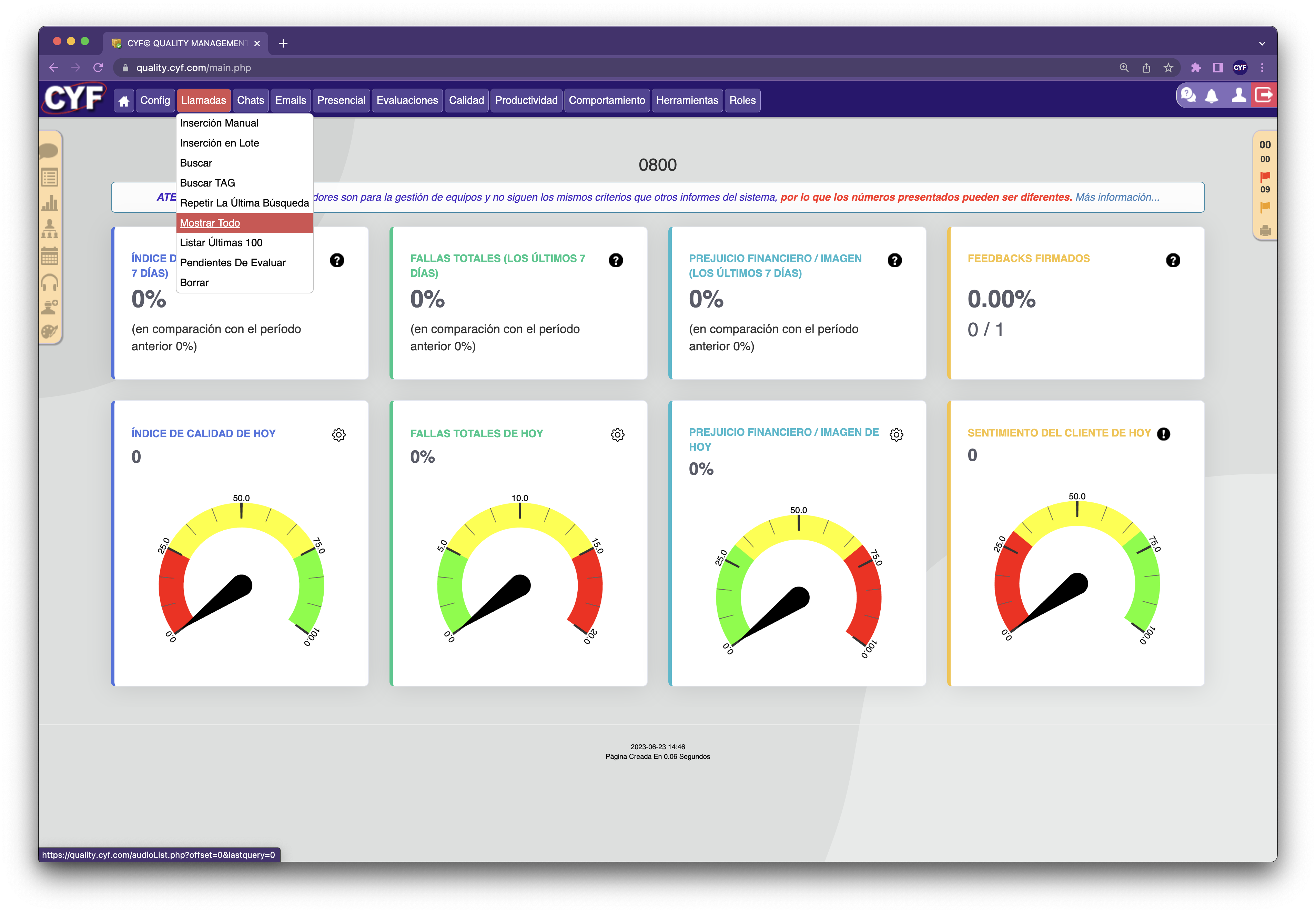
1 Enter or choose an existing contact
On the CYF Quality home screen, locate the service channel to be used for calibration. Enter a new contact or select an existing one from options within the service channel:
- Search: In this option you can select filters to search for the desired contact.
- Show all: This option will bring the last entered contacts.
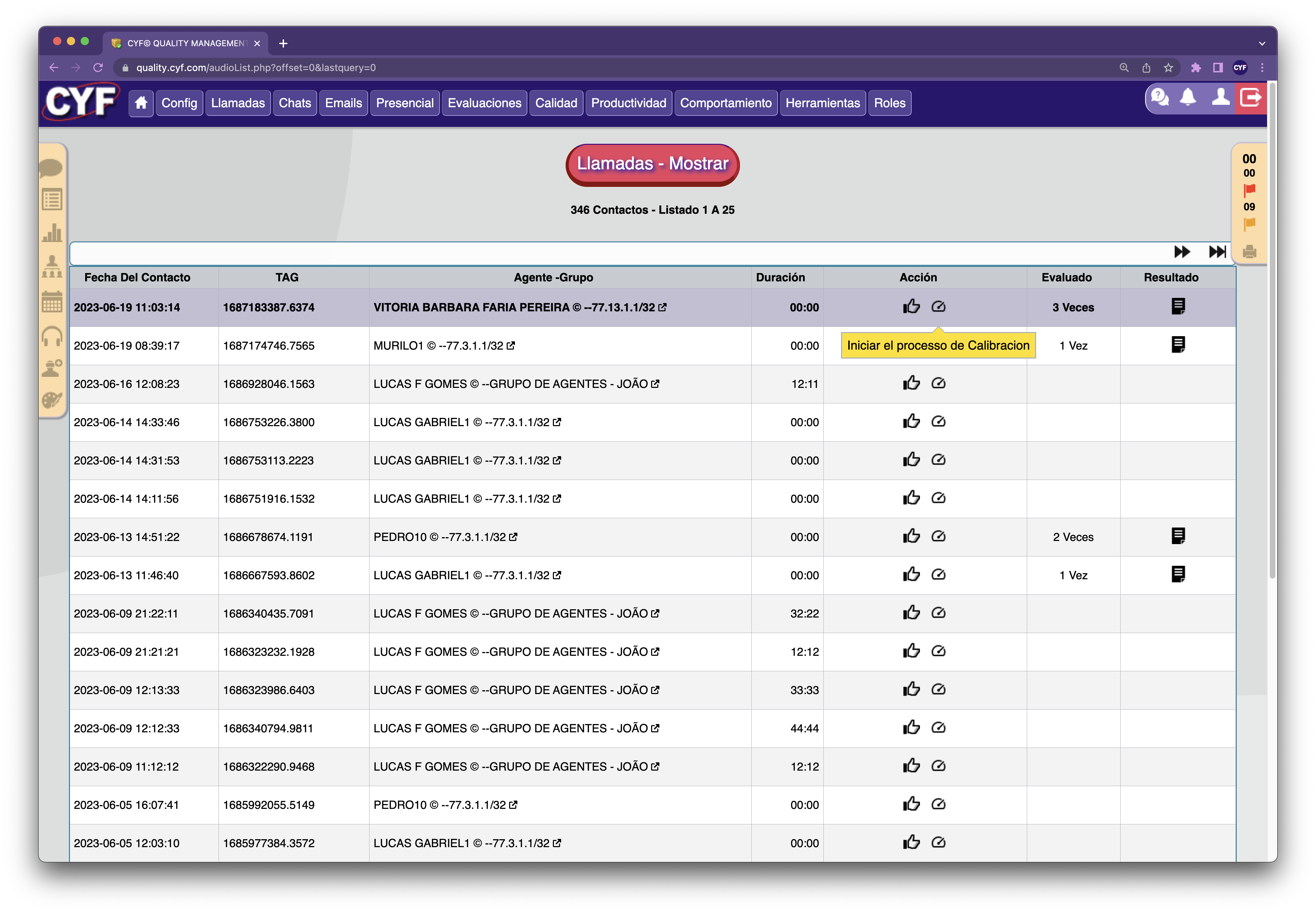
2 Click the "Start calibration process" icon
Once the desired contact is selected, click the icon to start the calibration process.
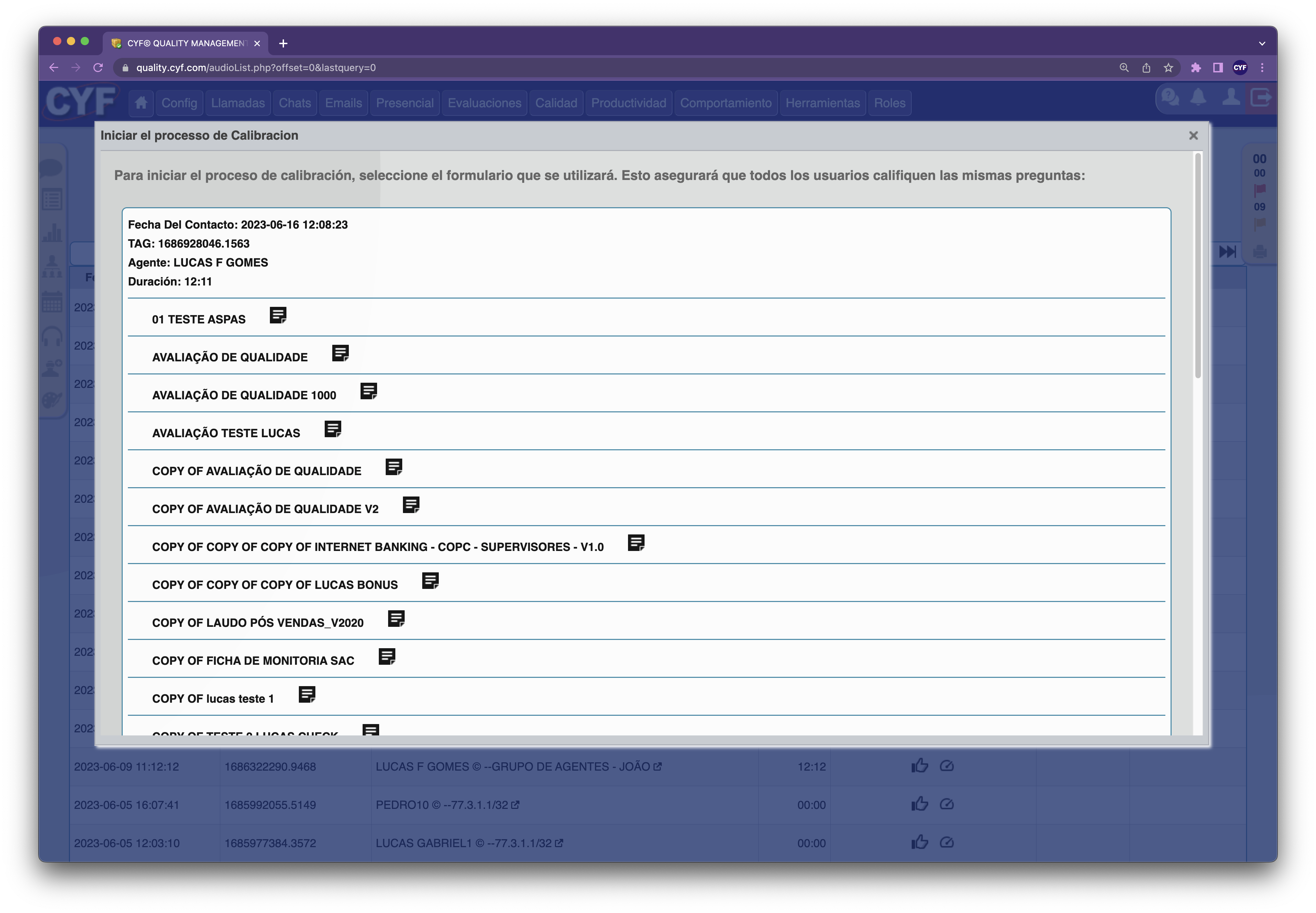
3 Choose the desired form
After starting the calibration process, you'll be directed to a page where you can choose the specific form to be used for evaluation. Select the appropriate form that best suits calibration process needs.
4 Fill in essential calibration information
In this step, you must provide essential information for calibration. Fill in the deadline to perform calibration, defining a deadline to complete the process. Additionally, provide a meaningful name for the calibration process that identifies it clearly and uniquely.
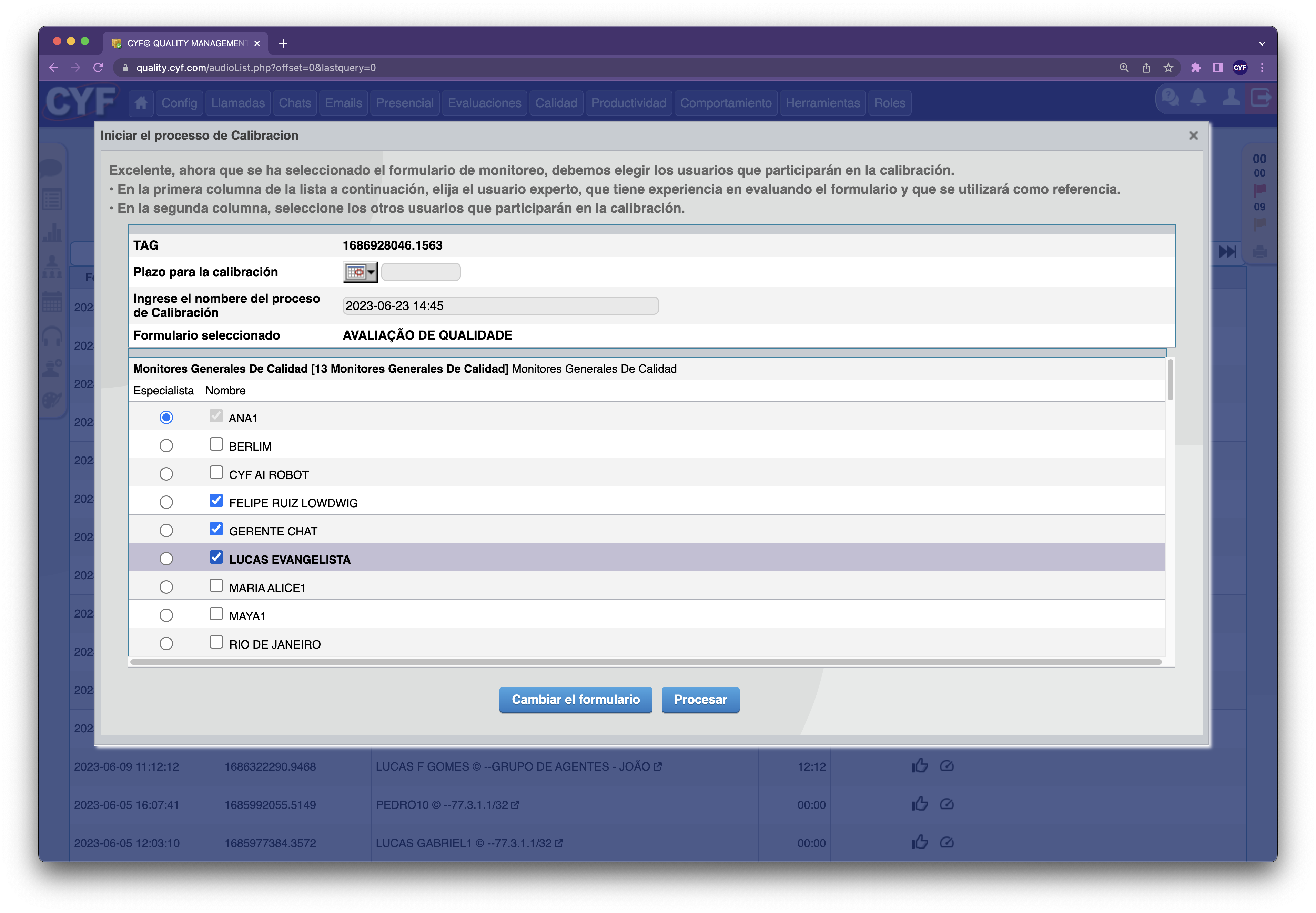
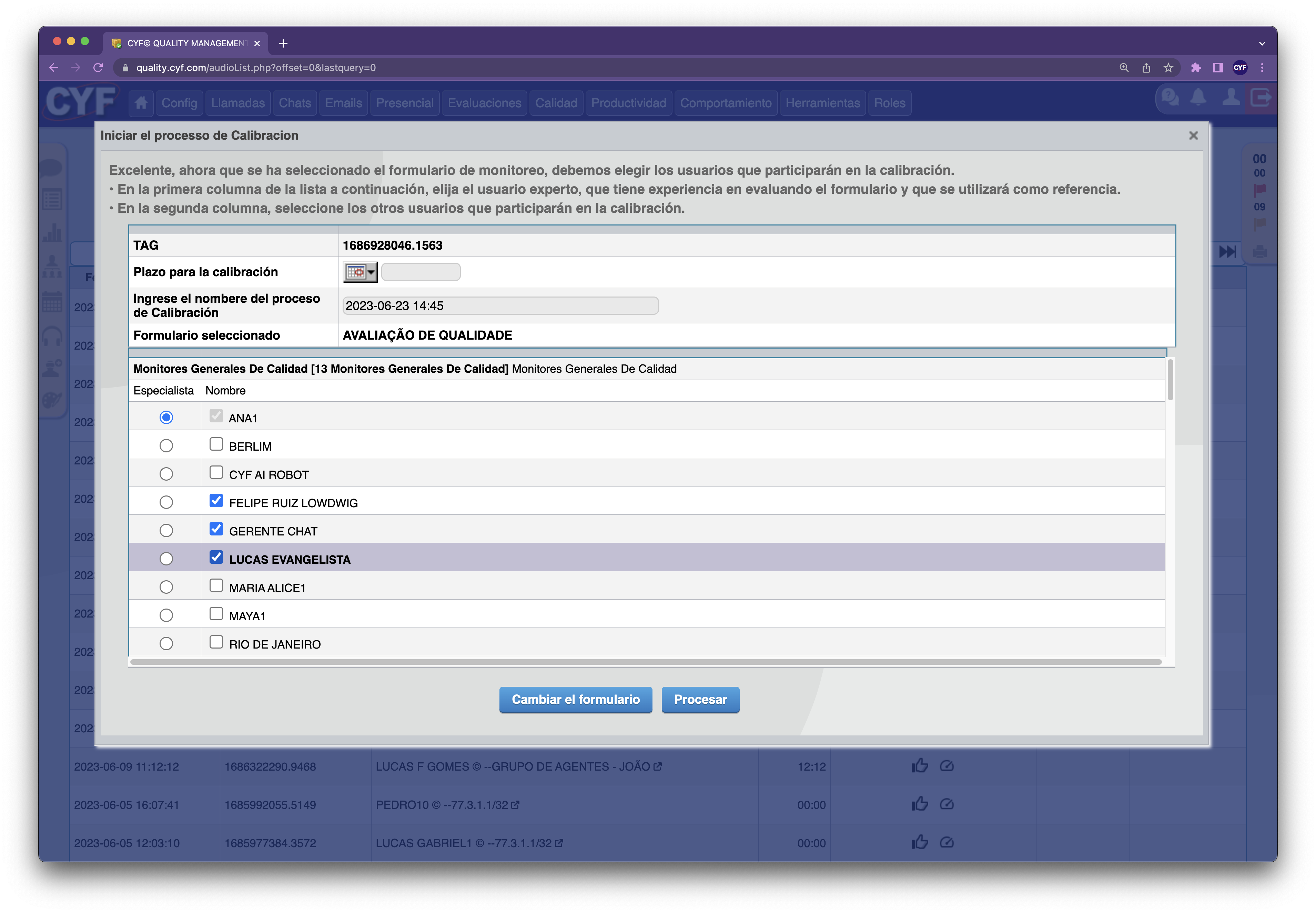
5 Define participants
Now it's necessary to define calibration process participants. Select the specialist responsible for performing calibration and evaluations. Additionally, you can add other users who will also participate in the process, such as other monitors or supervisors.
6 Finalize the process
After completing all information and defining participants, complete the calibration process. Verify that all information is correct and confirm calibration process creation in CYF Quality.
Once done, remember the following points:
- • Calibration will be available in the service channel in the 'Pending evaluation' submenu.
- • Calibration participants will be notified by email and when accessing CYF Quality.
- • Results will only be visible after all participants have completed monitoring or when the deadline has passed.
7 Follow results through reports
Once the calibration process is finished, you'll be able to follow results through reports generated by CYF Quality. These reports will provide detailed information about identified deviations, scores assigned by evaluators, and other relevant metrics. Use these reports to analyze and take appropriate actions to improve service quality.
Average
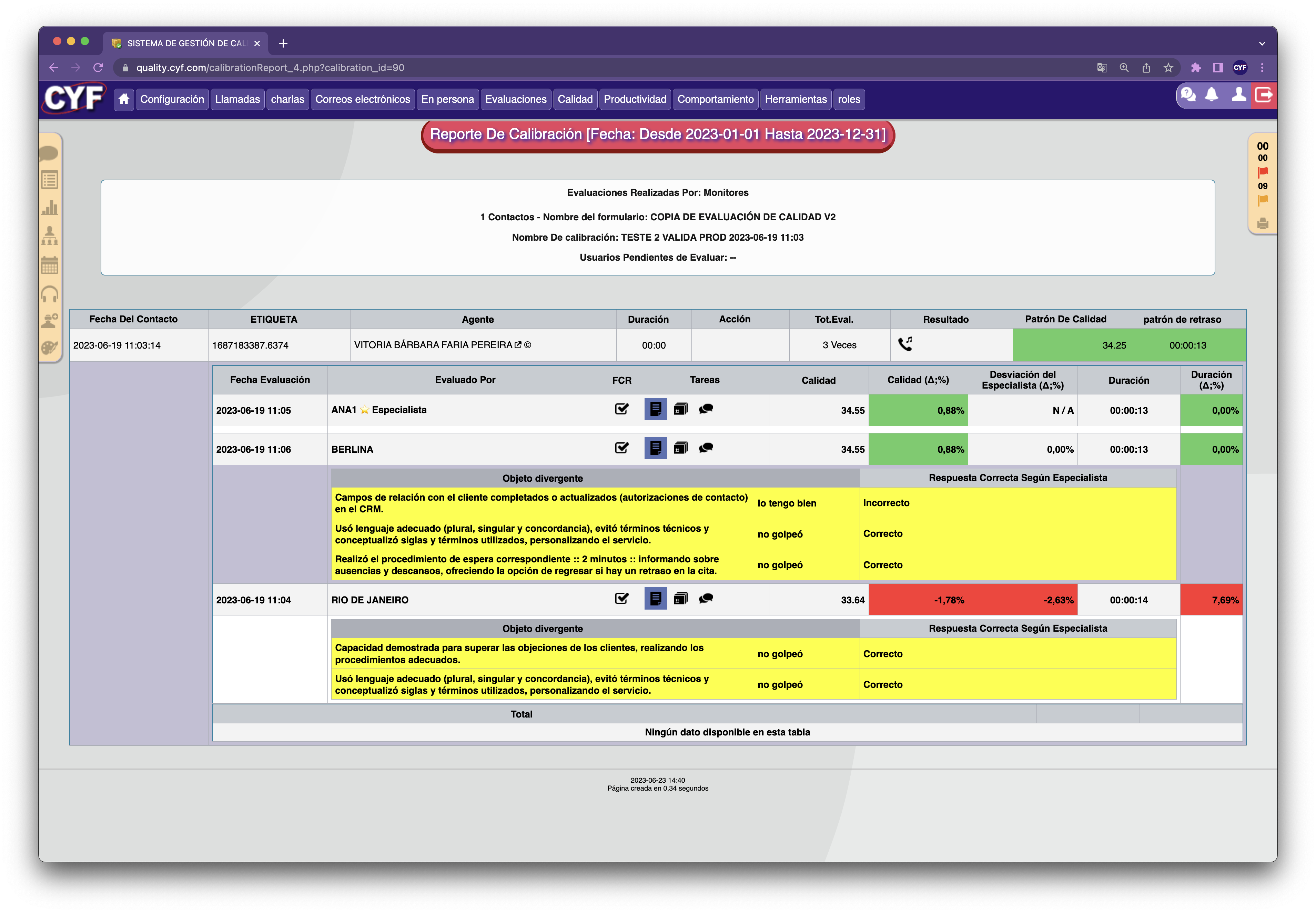
The first view you have is the overall average of scores and average time taken for evaluation of all participants.
Columns
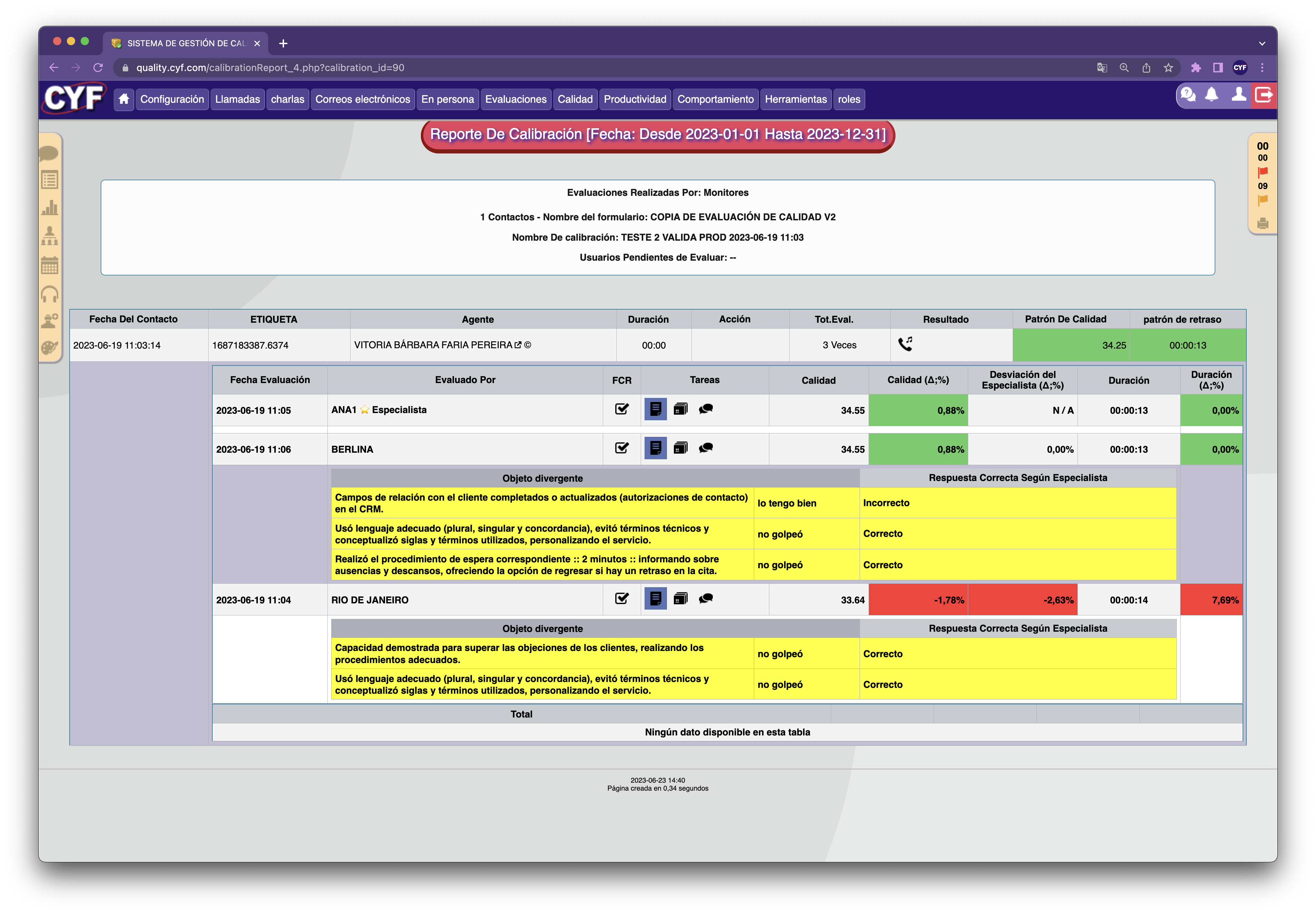
See that below averages, you have access to views of all participants. Let's understand the columns:
- Quality: See the score each evaluator applied to the contact.
- Quality (Δ,%): See all evaluators' deviation from overall review average.
- Specialist Deviation (Δ,%): Understand evaluators' score deviation compared to specialist.
- Duration: See time spent by each evaluator to perform calibration.
- Duration (Δ,%): Compare each evaluator's duration with all evaluators' average.
The Complete 2026 Guide:
AI in Quality Assurance
Discover how QA leaders are using AI to cut 80% of manual evaluation time and boost consistency by 95%
AI Auto-Scoring
How to implement automated evaluation in your call center
Predictive Analytics
Identify issues before they happen with machine learning
Proven ROI
Real cases of companies that transformed QA with AI
Be the First to Get It
Sign up now and receive the complete guide for free as soon as it launches
🔔 Get the Free GuideReady to Transform Your QA Process?
Take your quality assurance to the next level with CYF Quality — the AI-powered platform trusted by users worldwide.
Try CYF Quality for Free →Conclusion
Calibration in quality monitoring is an essential process to ensure consistency, accuracy, and fairness in agent evaluations.
Through careful selection of contacts used as reference, involvement of an experienced specialist, participation of the entire monitor team, deviation comparison, and constructive discussions, it's possible to obtain a more aligned evaluation and provide effective feedback to operators.
Calibration should be performed regularly to track progress, identify trends, and promote continuous development of the quality monitoring program. By investing in this process, call centers can achieve a higher level of excellence and customer satisfaction.